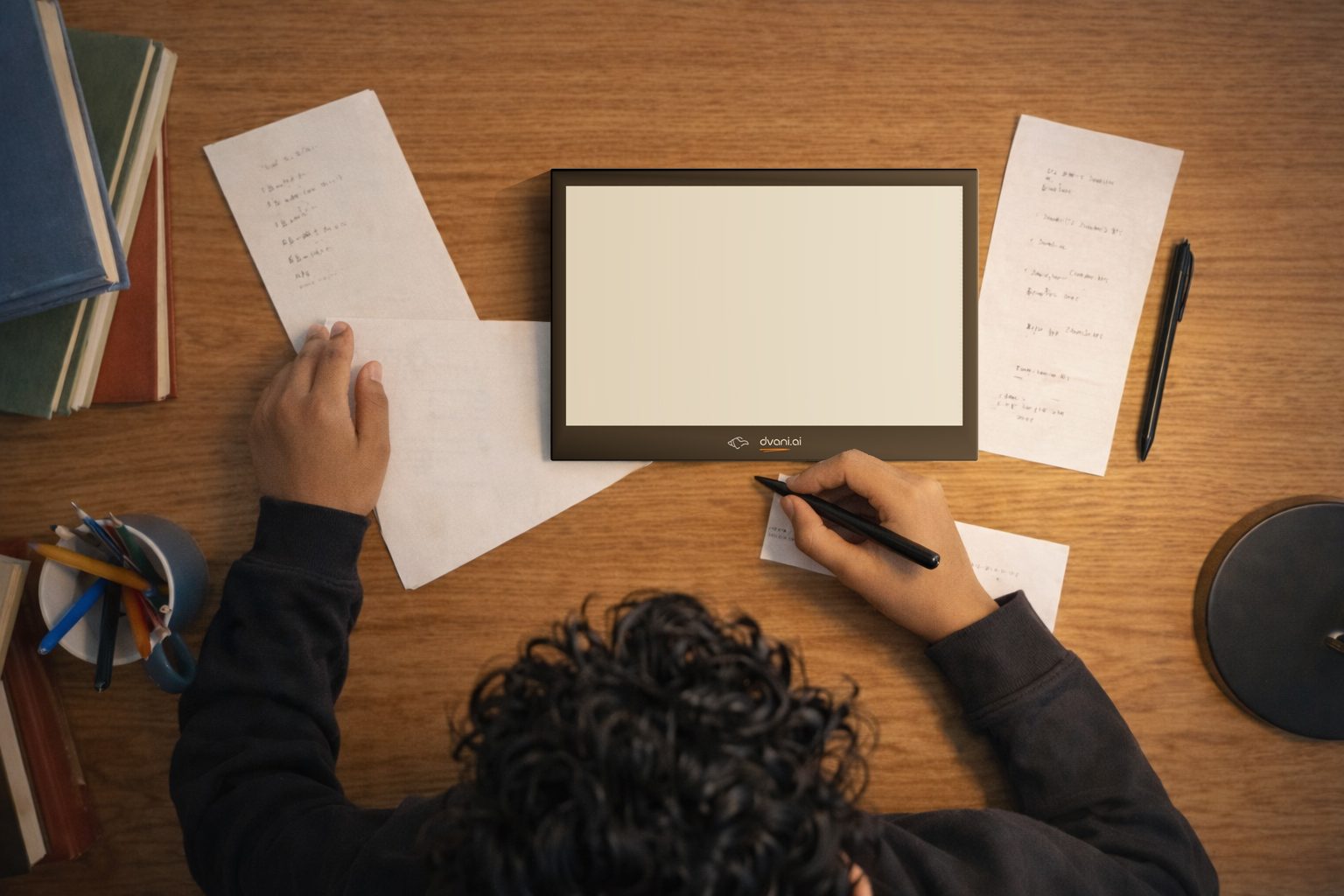
A connected notebook captures your working. An Dvani Slate brings together spoken guidance and illustrations, helping you understand a problem one step at a time.
Slate + connected notebook ₹7,200. Subscription ₹1,200 a month, bought separately. Ordering opens when the order flow is ready.

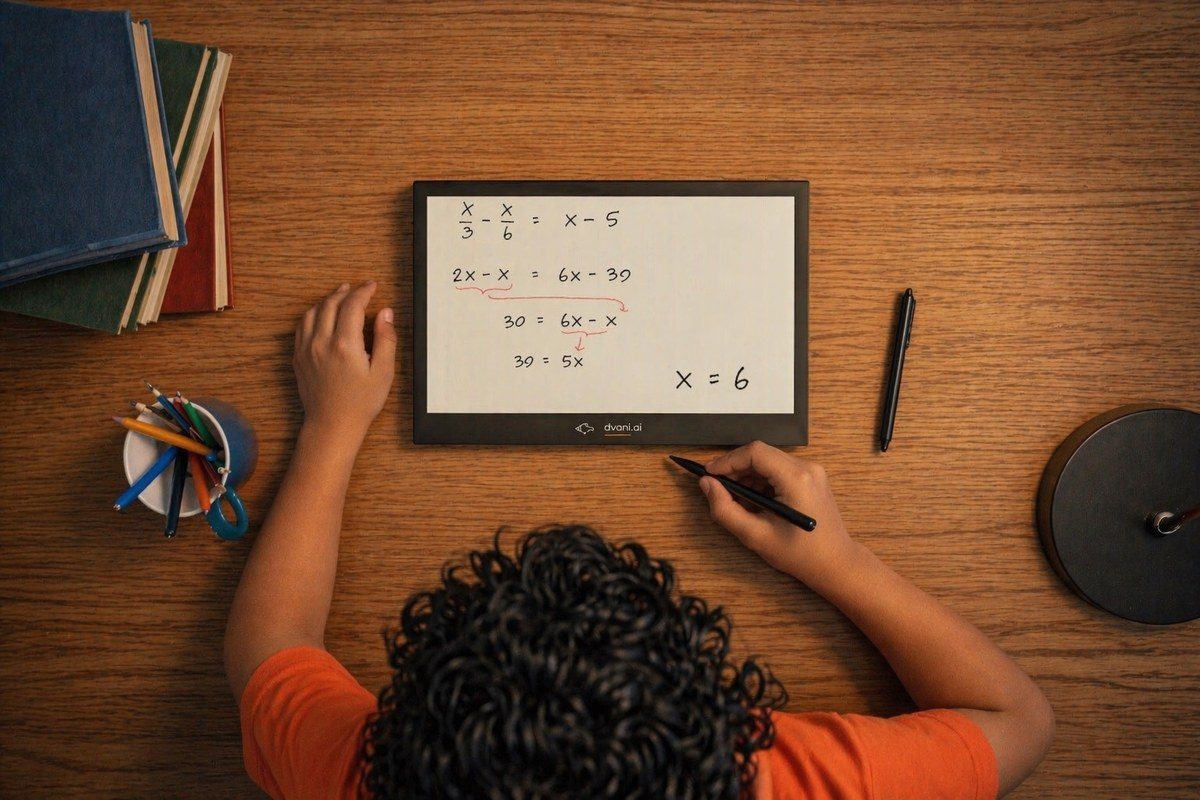
A student simplifies a fraction incorrectly on the way through an integral. Dvani points at that step and asks, “What is a quantity divided by itself?” The student answers “One”, revises the step, and carries on to the answer.
The film of this sequence is being made. It will be labelled as an illustration unless it is a recording of the physical prototype.
They write in the notebook — real ink, their own working, at their own pace. Nothing to log into, nothing to photograph. When they're stuck they double-tap the slate and say so. It answers with a question, and while it explains, the diagram appears on the page.
Ask it to check, and it already has the working, stroke by stroke, in the order it was written — so it marks where the thinking went wrong, not just where the answer did. Then, in Show mode, your child is the guest on a two-voice programme, answering questions about what they just studied. Explaining it out loud is what makes it stay.

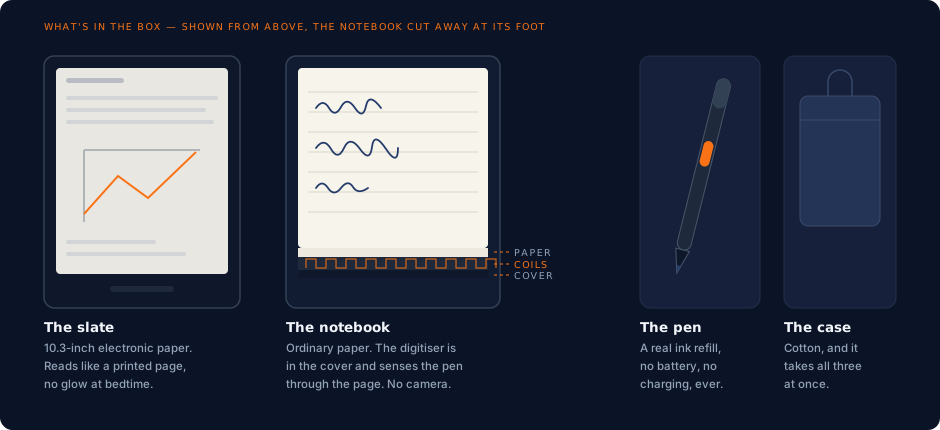
Ekalavya is not a tablet. It is electronic paper that reads like a printed page and doesn't glow at bedtime, and a real notebook that senses the pen through the paper.

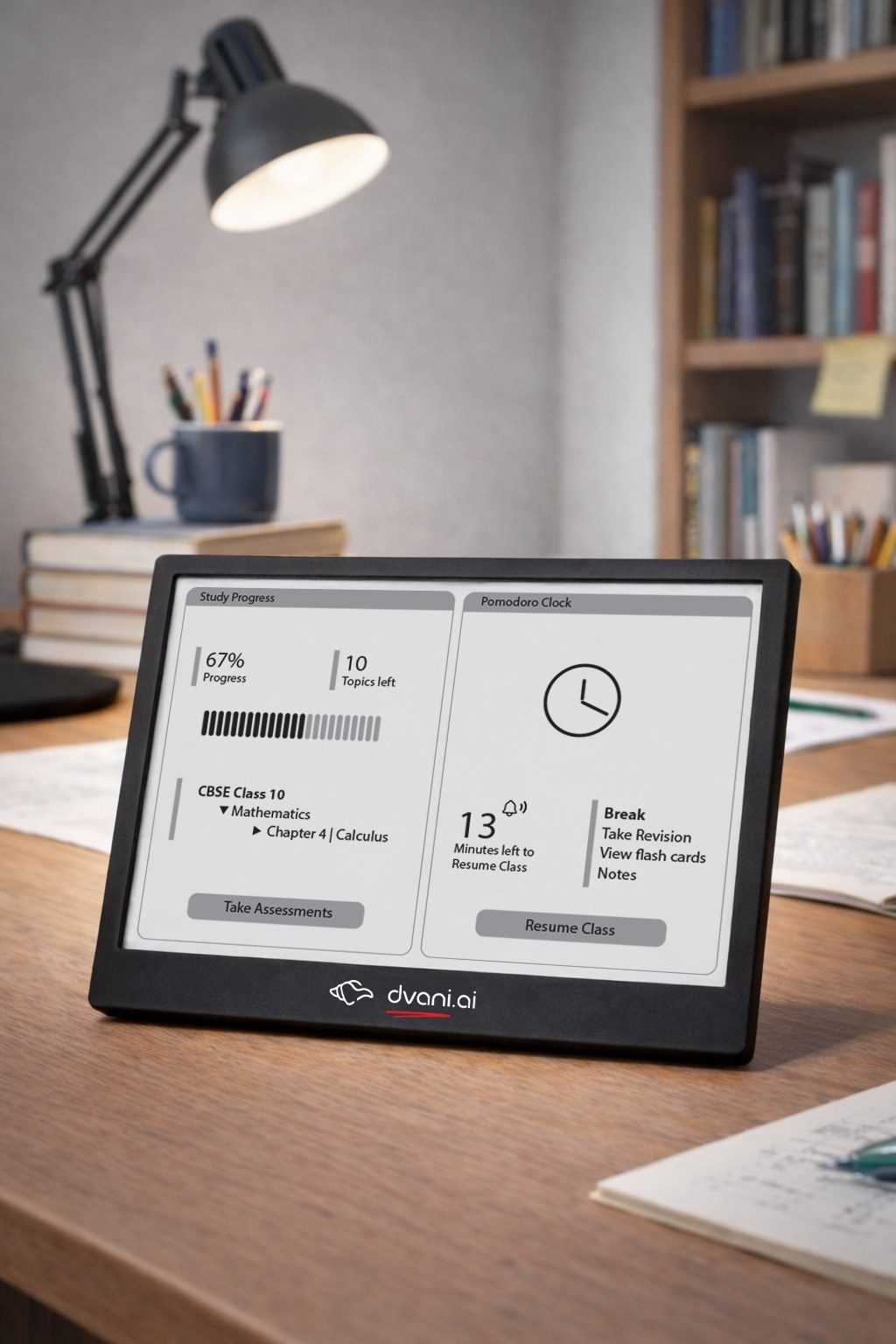
10.3-inch electronic paper, a pen, a microphone and a speaker. It listens when you press, explains in your language, and draws while it explains. Battery life is measured and published before it ships.

A digitiser in the cover senses the pen through the page — no camera, no scanning, nothing to line up. The pen carries a real ink refill and needs no battery, so the page fills with ink the way any notebook does while the slate follows every stroke. Refills in ruled, dot-grid and plain.

No phone, no tablet, no app for the student. One device built for one job, and a notebook that keeps them writing by hand.
Same voice, same habit of asking first. Double-tap the conch and speak, or type. Try "explain photosynthesis" and then "show me on the slate".
When a student is stuck on a step, Dvani asks what they think is happening before it explains — because a student who has to look at their own reasoning remembers the correction. Not every exchange is a question; asking for a straight explanation gets one.
Double-tap and talk. "I don't get step three." No wake word to remember, no app to open.
"What do you think happens to the ball when the force stops?" One question, at their level, before anything is explained.
The diagram appears on the slate as the explanation happens, so the words and the picture arrive together.
A follow-up question on the same idea, to check that the explanation landed rather than just sounded right.
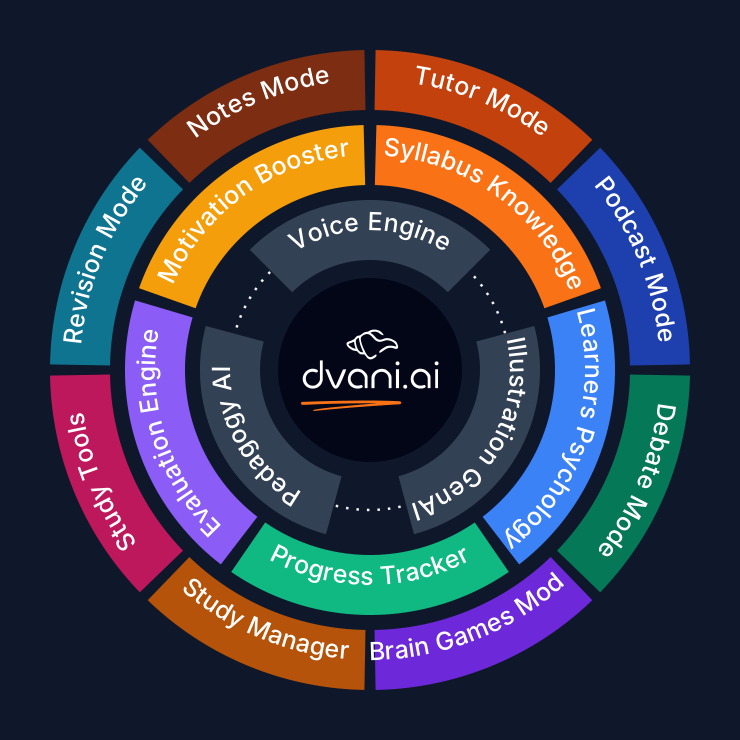
Lesson mode — learn with explanations you can question. Dvani introduces an idea with spoken guidance and illustrations. Ask a doubt aloud, or work an example through in the connected notebook.
Podcast mode — learn through a conversation you can join. An AI teacher and a virtual student discuss the topic, so the learner hears the questions being asked as well as the answers, and can step in.
Brain Gym — make room for a different kind of thinking. Chess and puzzles built around logic, reasoning and memory. We will name the specific activities and any multiplayer options once each has been through product testing, and we make no claim that they measurably improve intelligence or memory.
Lesson and Podcast are confirmed product directions. Which is ready first, and what else joins them, is not settled — earlier copy listed eight modes, which was a plan rather than a product.
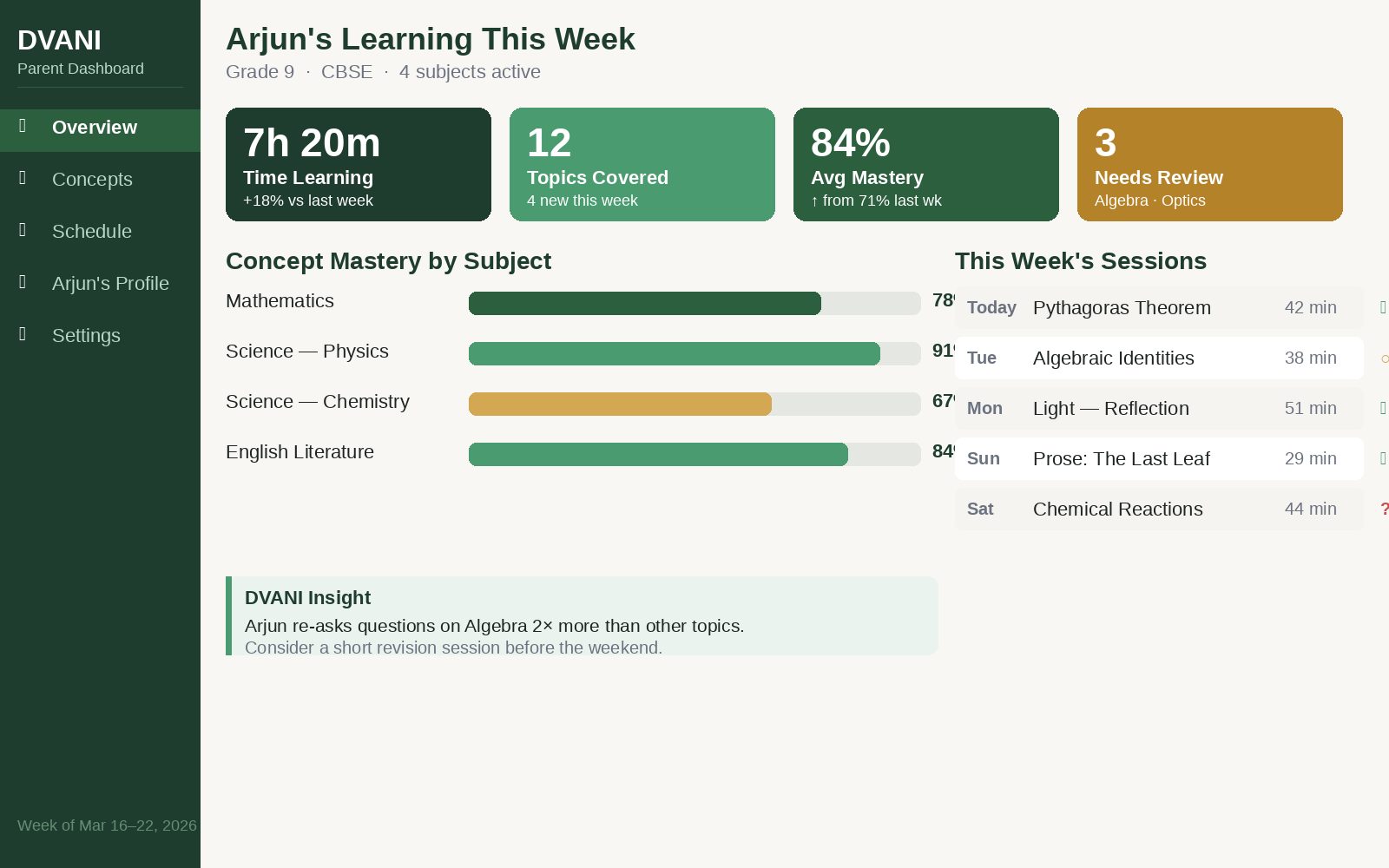
The parent app shows what your child asked and explored, so you're never guessing. It won't show you a child's work until your consent is recorded — that is the rule, and the system enforces it. Consent today is recorded rather than independently verified; verified consent is being built.
What they say becomes text. We do not clone voices, nothing a child says is used to train a model, and there are no ads and no data sold. The exact retention period is published once it is tested — see privacy.

Ordering opens when the order flow is ready.
Bought with the kit, or on its own for a slate you already have.
One child per slate. It learns how they get things wrong, which is not how anybody else does. A second child needs a second one.
What your child says becomes text. The audio is deleted.
And we don't identify anyone by it. Children are never cloned.
Their work is theirs. It is never used to train a model.
Not now, not later. We do not sell or share what a child asks.
The microphone opens on a press or the wake word, and at no other time. Parents and teachers can read what was asked, and deletion is available on request. The exact retention window is published once it is tested.
Those were built for adults, and they cannot see what your child wrote. Dvani works from the chapter they are on and from their handwriting in the connected notebook, and it guides them through a step rather than handing over a finished answer. It is also electronic paper rather than a backlit screen, with no feed and nothing else on it to open.
Yes. Dvani is pre-trained on your child's exact syllabus and exam pattern — chapter by chapter, paper by paper. Regional and state boards are mapped on request.
Save a lesson while you're online and it keeps the voice, the drawings and the timing. It replays complete with no connection at all — on the bus, or when the line goes down. Record once; replay anywhere.
At five, the world is one giant "why?" Dvani answers gently, in voice and pictures, turning curiosity into confidence. It is built for Class 4 and up, but a curious younger child is not turned away.
It becomes text and the audio is deleted. We don't copy their voice, and nothing they say trains anything. No ads, no data sold. Built to DPDP, COPPA and GDPR requirements.
Electronic paper reflects room light instead of emitting its own, so a page of working looks like a page rather than a screen, and there is no feed or notification on it competing for attention. We do not make health claims about eye strain; the reason we chose it is focus and the way handwriting reads on it.
You keep an hour a day, and the slate stays yours. We're not taking a device out of a child's hands over a missed month.
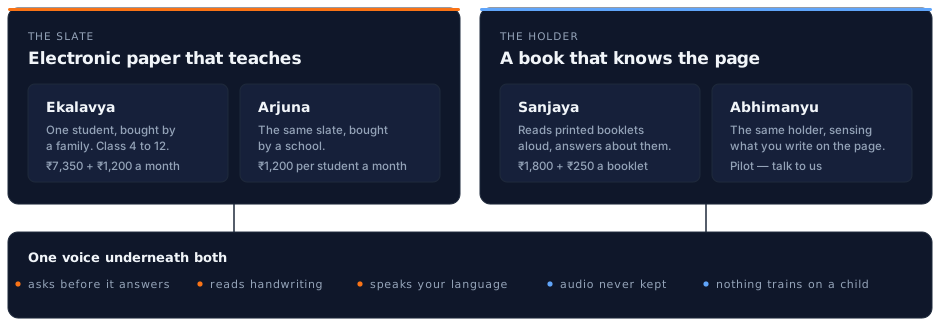
The Dvani Slate is sold to a family as Ekalavya or to a school as Arjuna. Saarathi is the folio: it reads printed booklets aloud and reads what you write on its EMR pad. Learn the pattern once and every product page reads itself.
One slate. Ekalavya is how a family buys it (₹7,200 once, plus ₹1,200 a month); Arjuna is how a school does, priced against the deployment.
One folio. It reads printed booklets aloud and answers about them, and its EMR writing layer lets dvani read what you write (₹2,200 once, included in every course bundle; booklets from ₹250).
Asks before it answers · reads handwriting · speaks your language · audio never kept · nothing trains on a child.